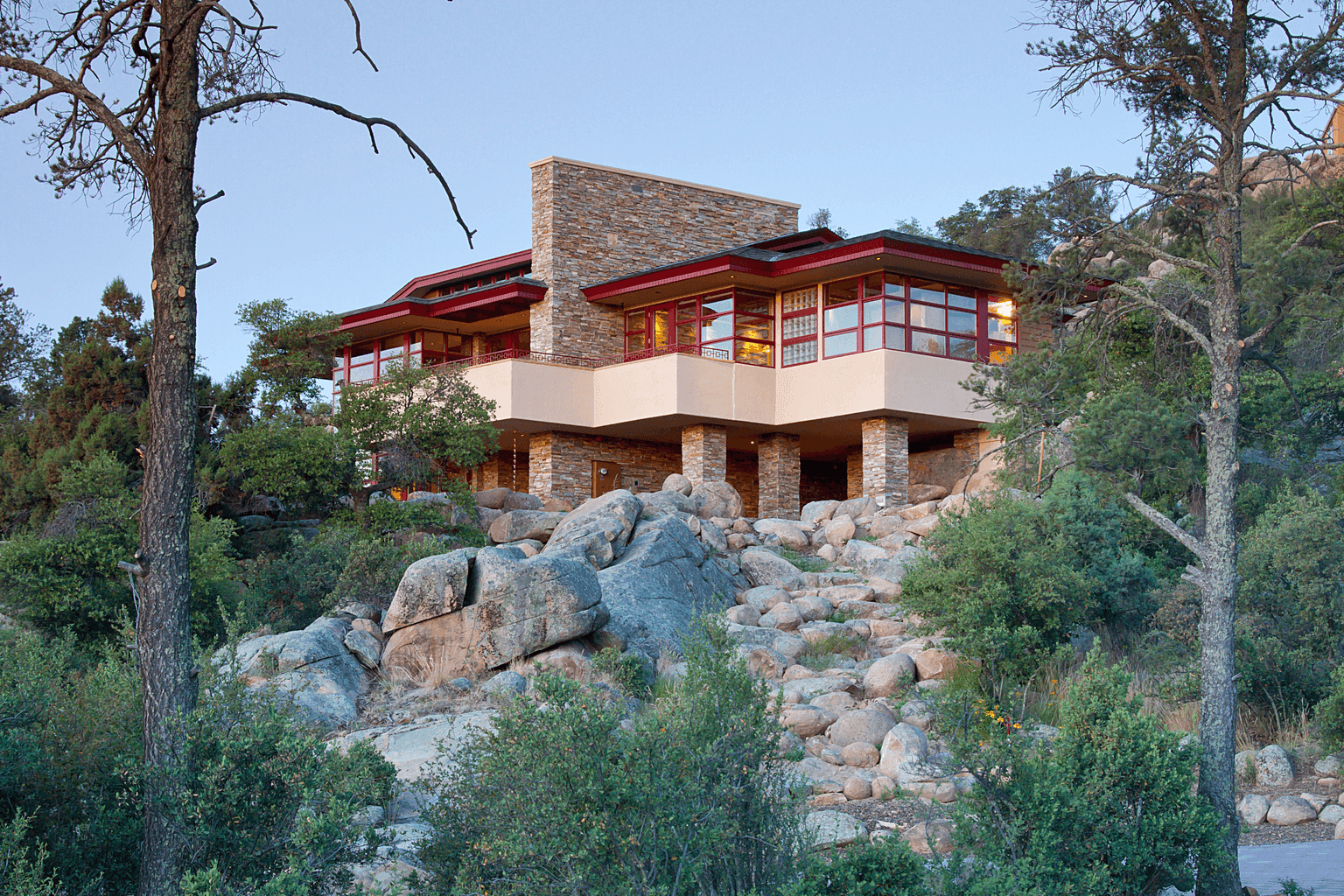
On a late-spring afternoon in the East Valley, a house Michael Rust designed sits low against its lot, the kind of low that takes work to achieve. Its long roof reaches past the walls, throwing a slab of shadow across the patio. The west-facing glass opens onto a stand of mesquite and a cleared view of the South Mountain ridgeline. The wind moves through a deliberate gap between two volumes. Nothing about it announces itself. That is the point.
Rust calls this organic architecture, and he is careful with the term. It is not green building, exactly, and it is not the box-with-a-trellis school of Sonoran modernism that has spread across Scottsdale and East Mesa over the past decade. It is something older. The houses are designed from their sites outward, shaped by the wind they will catch in May and the sun they will reject in July, not by a floor plan dragged in from somewhere else.
From a small town in Ohio to Taliesin
Rust grew up in a small town in Ohio, far from the desert where he now practices. He came to architecture the long way, by way of the firm that Frank Lloyd Wright left behind. Taliesin Architects, the successor to Wright's own practice, took Rust on early in his career. He worked alongside men and women who had themselves studied directly under Wright, the kind of teachers who corrected your elevations by asking what the door at the bottom of the page was trying to do for the people who would use it.
He left, eventually, the way most apprentices do, to test the lessons against other rooms. He went out to commercial firms, drew for a while at a remove from the Wright vocabulary, then returned to Taliesin. The second tour set him back into the older conversation about what architecture is for, and when he finally opened his own practice, he carried that conversation with him to Chandler.
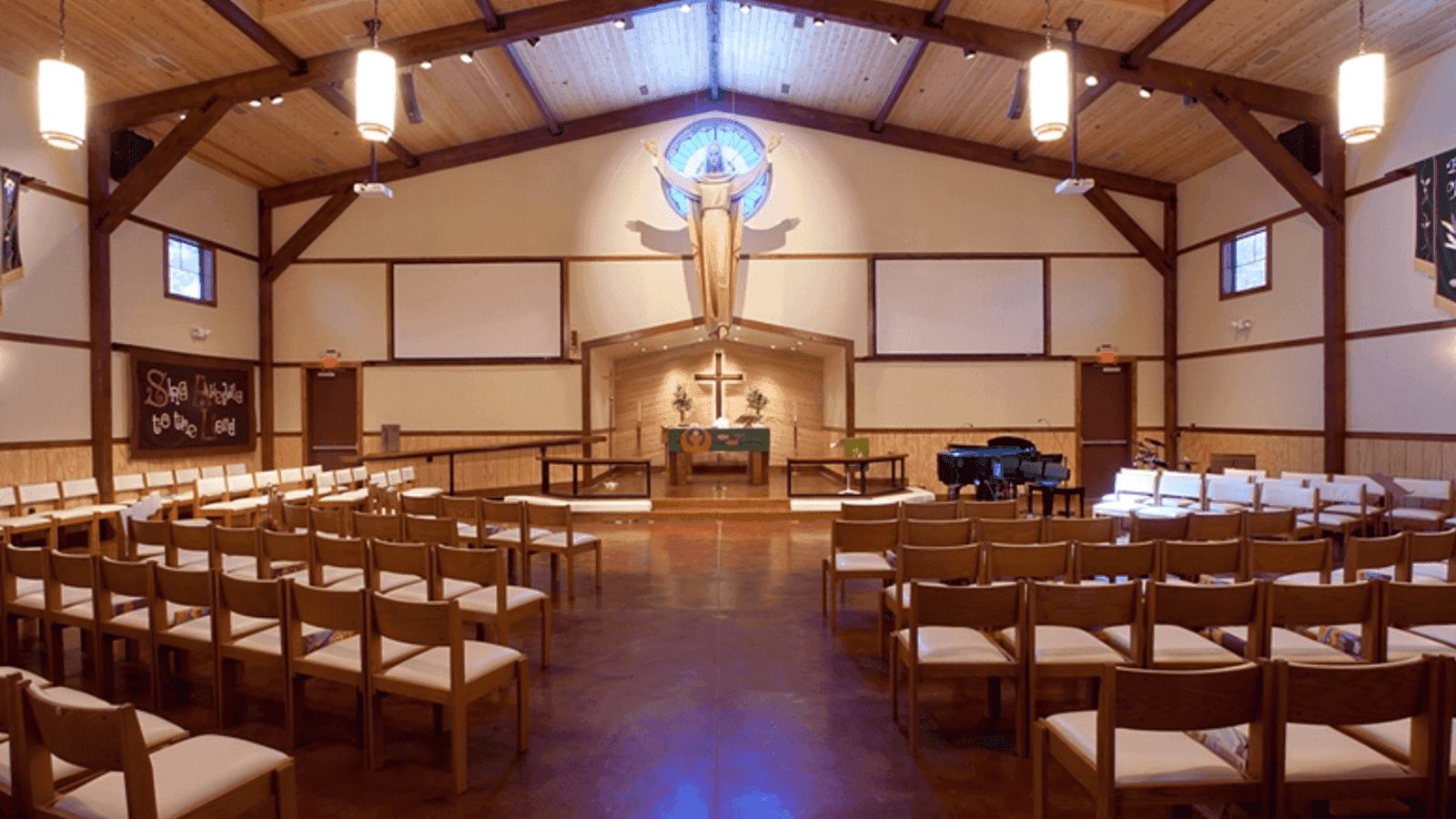
Twenty-five years later, his firm operates out of a studio on West McNair Street. The work fans out from there: residences in Arizona and Ohio, additions in West Virginia, a Lutheran church in the East Valley, an ice cream parlor he helped open in Glendale. The portfolio looks small on a screen and large in person, because the projects are designed to be experienced from inside them, not from a marketing render.
What organic architecture actually means
Ask Rust to define organic architecture, and he reaches for a metaphor before a definition. Architecture, he says, is like a suit. A custom suit fits the person who ordered it. It accounts for the slope of one shoulder, the way the wearer's arms hang when he is thinking, the work he does. The off-the-rack version fits no one in particular. It is a passable approximation of fitting many people.
Most houses, Rust argues, are off-the-rack. The same plan is reproduced across a hundred lots whose orientations and prevailing winds and street trees have nothing in common. The result is a neighborhood of approximate fits, where every front door faces west because the developer ran north-south streets, and every kitchen takes the afternoon sun whether the cook wanted it or not. The trade-off is volume and price, and Rust is the first to acknowledge it. But the work he does is the work that begins where that trade-off ends.
An organic house, by his definition, is one that could only exist on its particular site, for its particular client. The same plan reproduced one lot over would not work. The wind would be wrong. The view would be wrong. The way the morning sun hit the breakfast table would be wrong. The exterior is the consequence of what happens inside the rooms, not the other way around.
Bigger is not always better
It is hard to talk to Rust for more than a few minutes without the phrase coming up. Bigger is not always better. He says it the way a doctor says portion size, with the gentle insistence of someone who has watched the same mistake be made many times.
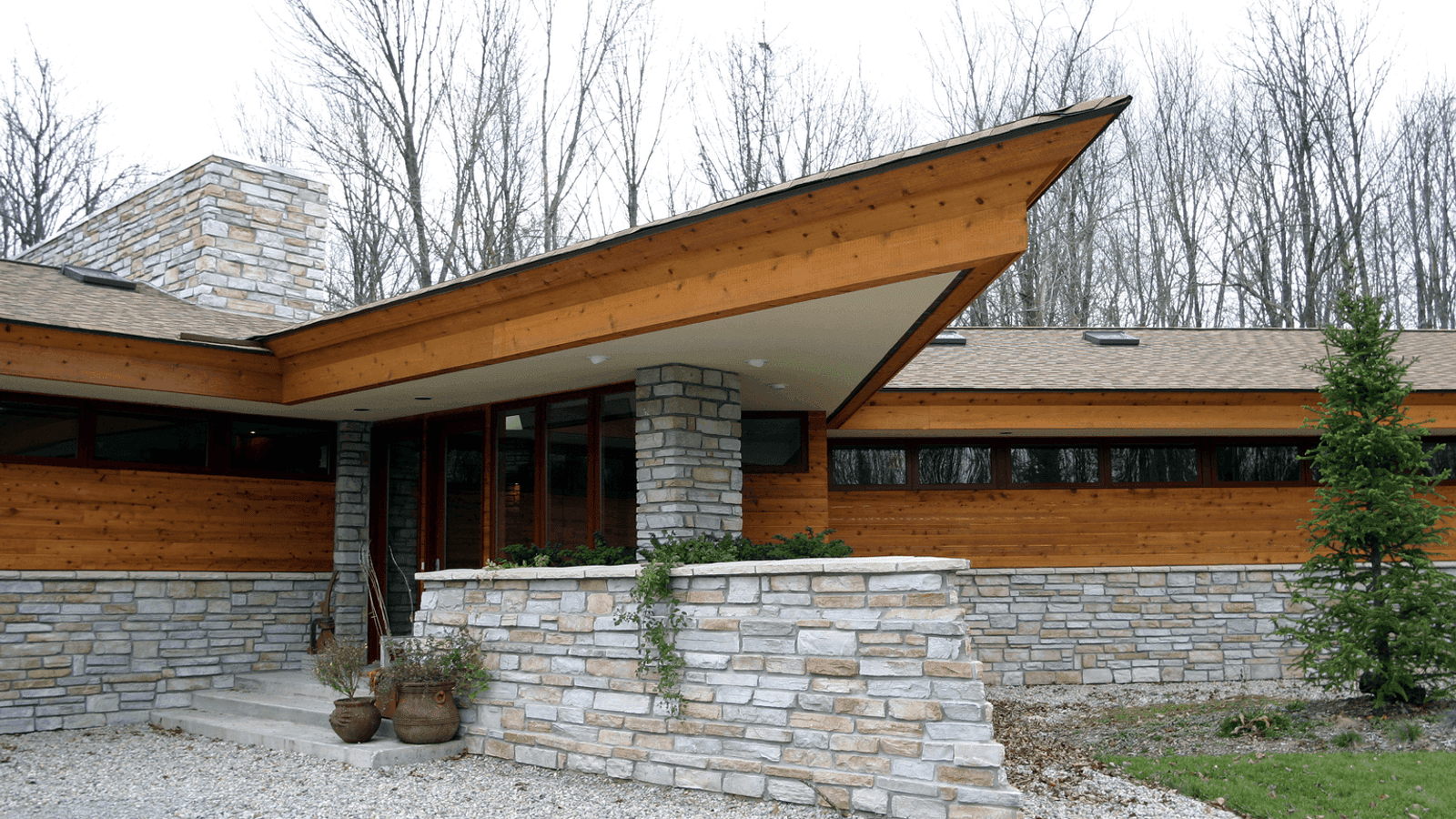
Square footage, in his telling, is a substitute for design rather than a feature of it. A 4,000-square-foot house with poorly placed windows lives smaller than a 2,200-square-foot house whose rooms unfold onto each other in the right sequence. The bigger one is also more expensive to cool, more expensive to insure, and almost always less photogenic from the curb. The clients who arrive at his door already knowing this are the easiest to work with.
Many of them arrive having read Frank Lloyd Wright. Wright's Usonian houses of the 1930s and 1940s, designed for middle-class families with carports and combined living-and-dining rooms, are the period of his work that Rust returns to most often in conversation. They were small. They were affordable. They were designed for the way people actually lived in them. Rust still draws additions and new homes in that lineage, and a fair number of his clients commission him precisely because they have studied the floor plans and want one of their own.
Designing from the site
A Rust project does not begin with a plan. It begins with the site. The first visit is a walk, usually with the client, often in late afternoon so the light is doing something legible. The architect notes the prevailing wind, the path of the sun across the year, the view that wants to be framed and the view that wants to be filtered. He notes the trees that will stay and the rocks that will not move. By the time he sits down at his drafting table, the site has dictated more decisions than any client conversation has.
From there the plan emerges in pencil. The early sketches are loose. They show the rough shape of the building and where it sits on the lot, with the wind drawn as arrows and the sun's arc drawn as a faint dotted line above. Rust adjusts these sketches against the client's program, the list of rooms and uses that the family has brought to the conversation, and slowly the building takes its specific form. The first set of computer renderings comes weeks later, and only after the building's bones are settled on paper.
Mike listened to our vision and crafted that into the design of a home displaying true genius. His understanding of how the various interior spaces flow together and how to bring nature inside was amazing.
The Lacey house, finished in Ohio, was designed entirely by email after a single site visit. That is unusual in the profession and a small revelation when it works. It works, in Rust's case, because the upstream conversations are exhaustive. By the time he is drawing, he is not guessing at what the family wants. He is solving for it.
Working with an organic architect
The process, by Rust's own account, runs longer than the off-the-rack alternative. A custom residence from first sketch to permit set usually lands between six and twelve months, depending on the complexity of the site and the speed of the client's decision-making. Construction adds another year or more. The clients who push back on the timeline are usually the ones who later thank him for it, the architect says, because the months on paper save them money on the dirt.
His drawings are detailed to a degree that contractors notice. The Bidingers, who hired Rust for a Phoenix-area residence in 2010, wrote afterward that they chose him precisely because he had a demonstrable record of integrating a structure's form and detail with the way a particular family actually lived. The drawings, in other words, were doing work that other architects' drawings were not.
Who hires an organic architect
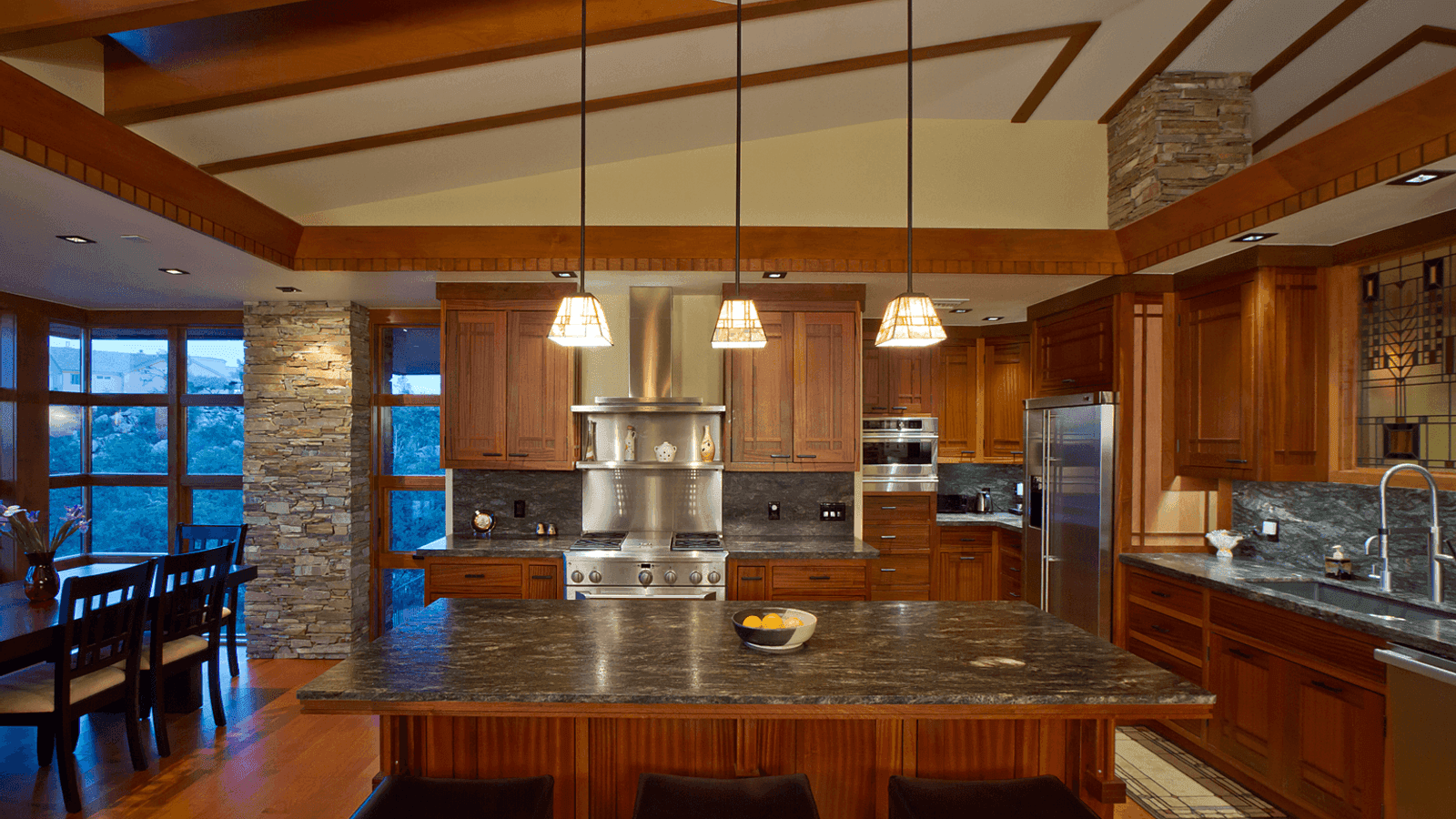
Rust's clients are not all the same. Some are retirees building their last house. Some are growing families on their second. A few are commercial clients who want a building that does more than enclose square footage. The thread is that they have already decided not to buy off the rack. They have done the reading. They have looked at the developer plans and known they wanted something different. By the time they call Rust, they are halfway down the road already.
Many of them mention Frank Lloyd Wright on the first call. Some have visited Taliesin West, the Wright winter campus in north Scottsdale, and walked out wanting a piece of that vocabulary in their own lives. Rust, who has spent a career inside that vocabulary, is candid about what is achievable. He will not build a knockoff. He will build a house whose principles are Wright's and whose particulars are the client's. There is a difference, and the difference is the whole project.
The Chandler studio
The studio on West McNair is small. Rust designs from it personally, with the help of a tight set of collaborators when the project demands. He renders his own work, runs his own permit submissions, and oversees the projects through construction. The firm is intentionally compact. He has been clear, over the years, that the size is part of the work. A larger firm would design more houses. It would not, in his telling, design them better.
From the Chandler office, he draws across state lines. Houses in Ohio. An addition in West Virginia. A small commercial space in Glendale. The geography of his portfolio is the result of clients finding him on the web, often after a long stretch of research, and emailing him before they call. He travels for the early site visit. The rest of the work happens at the drafting table and in the inbox.
The cost of architecture as a custom suit
Hiring an architect of Rust's caliber costs more than buying a stock plan, and Rust does not pretend otherwise. His residential design fees, like most experienced architects', land in the high single digits as a percentage of construction cost. On a $1.2 million custom house, that is meaningful money. He argues, persuasively, that it is also money that comes back over the life of the building, in lower energy bills, higher resale, and rooms a family actually wants to be in. The cheap version, by his accounting, is rarely cheap.
For clients who are not yet ready to commission a full custom design, Rust has published a book called the Right Plans Collection: forty floor plans, ranging from 1,600 to 7,000 square feet, drawn in the Wright lineage and available with modifications. It is a way into his work for people who admire it but are not yet ready for the full commission. Many of those readers become clients eventually.
What it means to live inside a Rust house
What clients describe, after they move in, is consistent. The rooms feel right. The light arrives where it should. The wind moves the curtains in the master in May without anyone having to open a window. The patio is shaded at exactly the hour the family wants to be out on it. The architecture, in Rust's words, enhances the quality of their lives. That is the entire pitch. That is what the long process and the higher fee are buying.
It is also what the Wright lineage was about, in the end. Wright believed that architecture could shape the way a family lived, that the right house could make better people of the ones inside it. Rust does not put it quite that way. But the conviction is the same. The houses he draws are designed for the lives that will be lived inside them. That is the test he holds his own work to. After a quarter-century, the houses keep passing it.
To begin a conversation with Michael Rust, Organic Architect, call 480-219-0554 or visit theorganicarchitect.com. The studio is at 1321 West McNair Street in Chandler, and the consultation is by appointment.