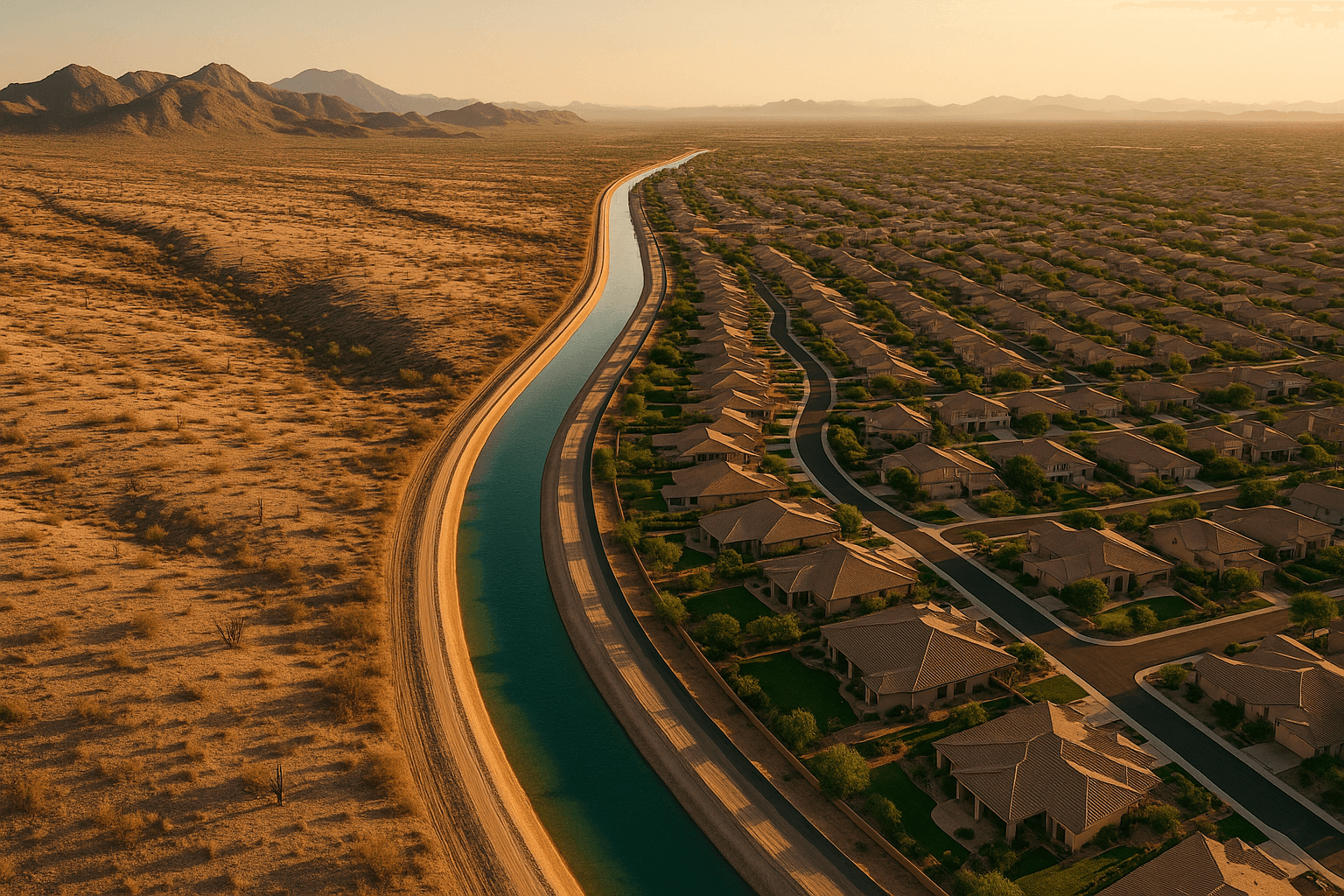
For nearly four decades, Arizona's 100-Year Assured Water Supply rule stood as the bedrock of the state's housing market. No subdivision could break ground without proof that enough water existed to serve its residents for a century. It was, by any measure, a bold bet on planning over politics — and it worked. Phoenix became one of the fastest-growing metros in the country, developers built with confidence, and buyers signed contracts knowing their faucets would run. That bet is now unraveling.
01The Rule Explained
Arizona's Assured Water Supply (AWS) program was born out of the 1980 Groundwater Management Act, a landmark piece of legislation passed after the state's aquifers had been drawn down to alarming levels. Under the rule, any developer platting land in one of Arizona's five Active Management Areas — the regions around Phoenix, Tucson, Prescott, Pinal County, and the Santa Cruz basin — must demonstrate a physically, legally, and financially assured water supply before the Arizona Department of Water Resources (ADWR) will certify the subdivision.
The standard sounds simple: prove you have 100 years of water. In practice, it required developers to secure contracts with cities or water providers, show the underlying source was renewable and reliable, and fund the infrastructure to deliver it. For decades, Central Arizona Project (CAP) water — Colorado River allocations pumped uphill through a 336-mile aqueduct — underpinned the math. As long as the river flowed, the numbers penciled out.
02What Changed in April 2026
On April 14, 2026, Maricopa County Superior Court Judge Patricia Blaney issued a ruling that has sent shockwaves through Arizona's development community. In Home Builders Association of Central Arizona v. ADWR, Judge Blaney upheld the agency's 2023 determination that groundwater supplies in the Phoenix AMA's far West Valley — particularly in the Buckeye and Tonopah sub-basins — could no longer be certified as physically assured for new large-scale subdivisions.
The ruling affirmed ADWR's authority to reassess prior certifications when hydrological data changes. It also declined to grandfather thousands of already-approved lots that developers had been banking on for future phases. In a single decision, an estimated 12,000 to 15,000 planned housing units had their water supply put in legal limbo. The Arizona Capitol Times reported that several major homebuilders halted grading operations within 48 hours of the ruling.
03The Colorado River Factor
The ruling didn't happen in isolation. It is the downstream consequence of a decade of drought and overallocation on the Colorado River. Lake Mead, which stores water for Arizona, Nevada, California, and Mexico, dropped to historically low levels between 2020 and 2024. The Bureau of Reclamation declared Tier 1 and then Tier 2 shortages, cutting Arizona's CAP allocation by hundreds of thousands of acre-feet per year. Arizona, as the junior appropriator under the Law of the River, absorbs cuts before Nevada or California.
When CAP deliveries shrink, cities and water utilities that had sold AWS certificates to developers found themselves short. Many had papered over the gap with groundwater pumping — which is precisely what the 1980 Groundwater Management Act was designed to phase out. ADWR's 2023 reassessment found that the West Valley's groundwater basin was being drawn down faster than it could recharge, making the 100-year math false.
The assured water supply program was designed for exactly this situation — to be the canary in the coal mine before we build houses that can't be served.
04Who Holds the Risk Now
The immediate losers are the builders who had paid for infrastructure — graded lots, paved streets, stubbed utilities — anticipating permits that now may not come. Meritage Homes, Taylor Morrison, and several regional builders have confirmed exposure in public earnings calls, though none have quantified the exact write-down. Land values in the affected sub-basins have already declined 20 to 35 percent in off-market transactions, according to brokers tracking the area.
For buyers, the picture is more complicated. Anyone who has already closed on a home in a certified subdivision is protected — their water rights were secured at the time of platting. The risk sits with buyers who signed contracts on future phases or in new communities that hadn't yet received ADWR certification. Some are now being offered contract cancellations; others are waiting to see whether developers find alternative water sources.
Municipalities face a different calculus. Cities like Buckeye and Goodyear had built their growth projections around the approved subdivisions. Reduced housing supply means reduced property tax revenue, which cascades into infrastructure bond capacity. Several West Valley cities are now lobbying the Arizona Legislature for emergency appropriations to pursue alternative supply projects.
05What Comes Next
Three paths are being actively pursued. First, some developers are negotiating water supply agreements with the Central Arizona Groundwater Replenishment District (CAGRD), an entity that can purchase and bank CAP water on behalf of developers who lack direct access. CAGRD enrollment is expensive and capacity-constrained, but it remains a legally recognized pathway to certification.
Second, a coalition of builders and the Arizona Association of Realtors is pushing SB 1422, a bill that would require ADWR to provide a 24-month notice period before withdrawing certification on previously approved lots. The bill passed the Senate in March but faces an uncertain reception in the House, where rural water interests are skeptical of anything that shifts supply risk onto the broader system.
Third, and most speculatively, Phoenix-area utilities are exploring advanced water recycling — treating reclaimed wastewater to drinking-water standards and injecting it into the aquifer. The technology exists and is in use in parts of California, but Arizona's regulatory framework for Direct Potable Reuse is still being written. Meaningful volume from that source is likely five to eight years away.
In the meantime, the housing market in the West Valley is in a holding pattern. Builders are quietly pivoting capital to the East Valley and the Scottsdale corridor, where CAP deliveries are more secure and water utility infrastructure is more mature. The irony is not lost on anyone: the rule that made Arizona's growth machine possible is now, for the first time, putting a hard ceiling on it.