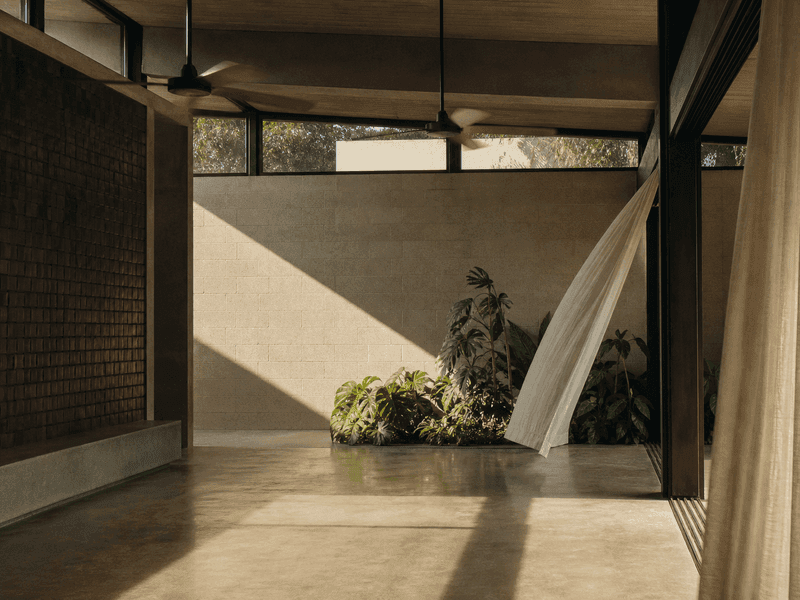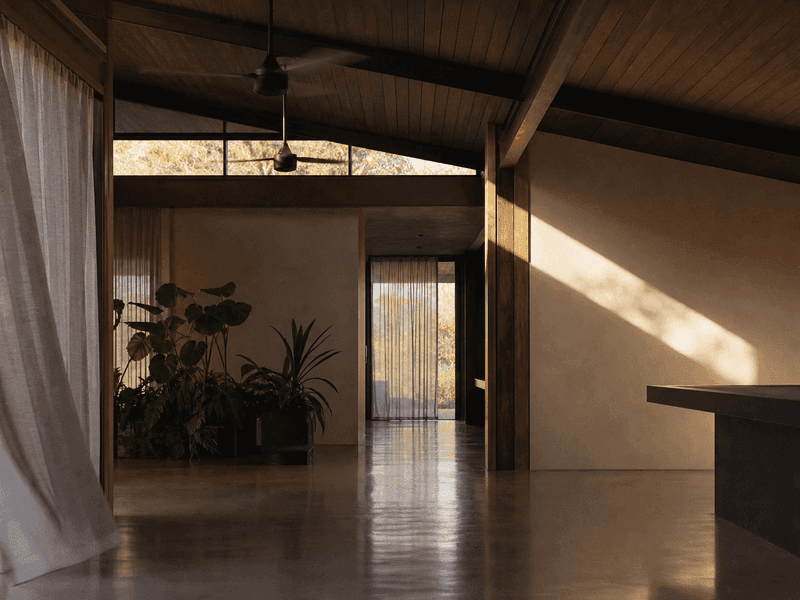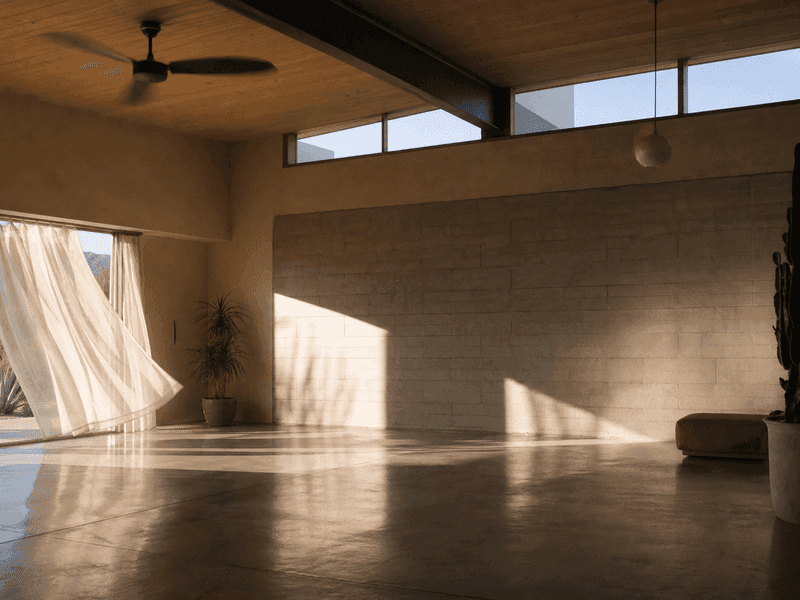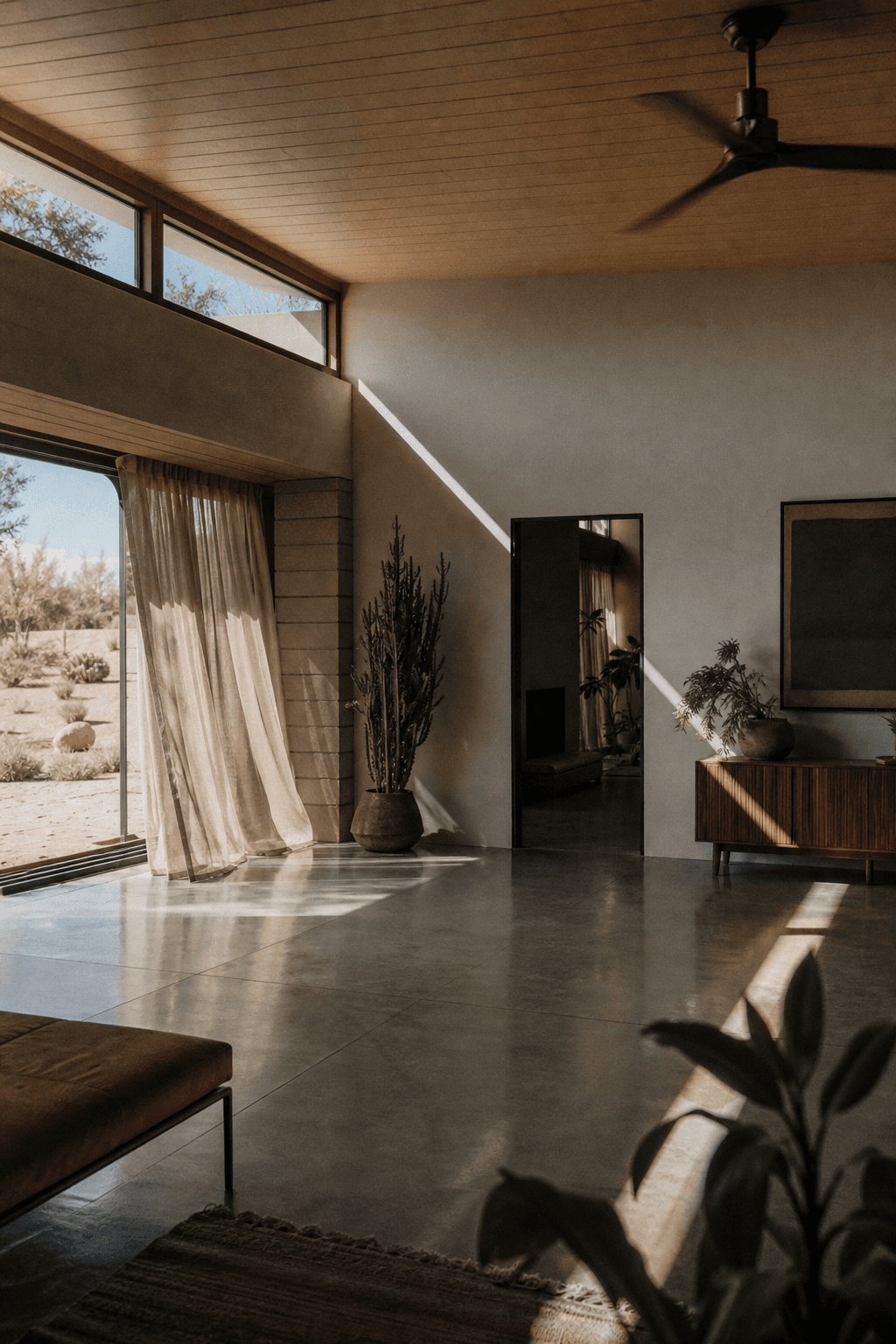
A Passive House certified home in the Sonoran Desert runs heating and cooling on roughly 19 percent of its total annual electricity. A code-minimum conventional build in the same climate zone runs it on 45 percent. That 26-point gap is the practical argument for passive design. It is also not the reason most people put rammed earth walls on their new build.
01What Passive Cooling Actually Means
Passive cooling is not a single technology. It is a collection of design strategies that reduce the amount of mechanical cooling a building needs: orientation, shading, thermal mass, and natural ventilation. In the Sonoran Desert, the relevant strategies are specific to the climate — high ambient temperatures, very low humidity, and significant day-to-night temperature swings, particularly in spring and fall.
The temperature swing is the key mechanism. Phoenix regularly sees a 30-degree differential between the afternoon high and the pre-dawn low. Thermal mass and night ventilation exploit that swing: the building absorbs heat during the day and exhausts it at night, arriving at morning in a cooler state. In the hottest weeks of July and August, that strategy provides less relief because the overnight lows don't drop far enough. But for five or six months of the year, it meaningfully reduces mechanical cooling load.
02The HVAC Floor
Passive cooling in Arizona does not mean no air conditioning. It means less air conditioning, and better-sized air conditioning. A code-minimum home in Phoenix sized for the heat load it generates typically needs 4 to 6 tons of cooling capacity. A well-designed passive home of the same square footage might need 2 to 3 tons. That difference matters for equipment cost, operating cost, and comfort. Oversized AC units cycle on and off frequently, reducing dehumidification and creating temperature swings.
The high-performance mechanical systems now available — variable-refrigerant-flow systems, heat pump technology, smart zoning — are genuinely good and have come down substantially in cost. The argument for passive design is not that mechanical systems are inadequate. It is that a smaller, better-targeted system is more efficient and less expensive to run than a large one compensating for an unoptimized envelope.
A well-designed passive home might need 2 to 3 tons of cooling where a conventional build needs 4 to 6. That difference compounds over 30 years of utility bills.
03Where the Investment Makes Sense
The cost premium for genuine passive design — not a rammed earth accent wall, but an actual orientation study, calculated overhangs, optimized window placement — runs roughly 5 to 10 percent of construction cost on a custom home. On a $1.5 million build, that is $75,000 to $150,000.
The payback period depends on energy costs and how well the design is executed. APS and SRP rates have increased consistently, and the ROI case for passive design has improved accordingly. For a primary residence occupied for 10 or more years, the math generally works. For a spec home sold in three years, the developer captures none of the operating savings and has limited incentive to invest. This is why most spec homes in the Phoenix metro are not passively designed regardless of the marketing language.
04The Honest Assessment
For most homeowners in the Phoenix metro, the practical question is not 'passive cooling versus HVAC' but 'how do I improve the performance of the house I have or am about to buy?' The answer involves specific steps: adding exterior shading on west and south exposures, sealing the attic properly, upgrading to a variable-speed system when the current unit dies, and being honest about how much of what is marketed as desert architecture is actually designed to perform.
The Passive House certification standard is a useful benchmark for what is actually achievable in the Arizona climate. Most homes will not pursue certification. But the principles behind it are not proprietary, and a design that follows them delivers real results on the utility bill.
The homes that perform best in Arizona summer are not complicated. They face the right direction, have real overhangs, have limited west glass, and have mechanical systems sized for the load they actually generate. Those decisions are made in design, not at the equipment dealer. Sources: arizonapassivehouse.com, passivehouseaccelerator.com, azsolarcenter.org